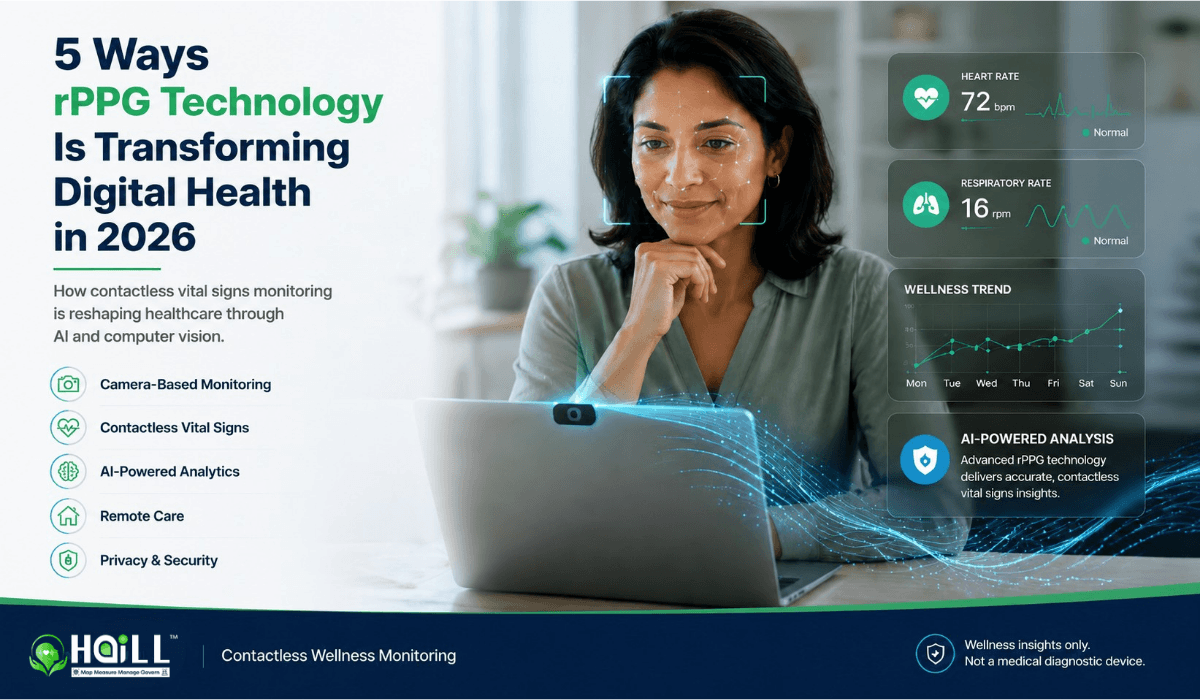
The camera on your laptop was never supposed to be a diagnostic instrument. Yet that is precisely what remote photoplethysmography rPPG has quietly turned it into. By reading the almost invisible colour shifts in a person's skin as blood moves beneath it, rPPG technology can now estimate heart rate, respiration rate, and other physiological signals using nothing more than a standard camera. No wearable, no cuff, no contact. Just light, video, and an algorithm doing the work a sensor used to do.
This isn't a lab curiosity anymore. As NHS digital transformation strategy continues to push care out of clinical settings and into homes, workplaces, and everyday devices, contactless monitoring is moving from novelty to necessity. Here are five ways rPPG is reshaping what digital health looks like in 2026 and where platforms like HaiLL fit into that shift.
1. It's Turning Any Camera into a Vital Signs Sensor
The core insight behind rPPG is deceptively simple: every heartbeat pushes a small pulse of blood through the capillaries near the skin's surface, and that pulse changes how much light the skin reflects. A standard RGB camera the kind already built into every laptop, tablet, and smartphone can pick up that signal. No specialist hardware is required. What used to demand a finger clip, or a chest strap can now happen through a 30-second video clip, which is precisely why rPPG has become the fastest-growing category in contactless health tech.
2. It's Removing the Biggest Barrier to Regular Monitoring: Friction
Wearables solved a lot of problems, but they introduced a new one: people stop wearing them. Devices get left on nightstands, batteries die, straps get uncomfortable. rPPG sidesteps the entire adherence problem. There's nothing to charge, nothing to strap on, nothing to remember. That has real consequences for population-level health monitoring, particularly for older adults, care recipients, and anyone for whom a wearable simply isn't practical or welcome.
3. It's Making Enterprise-Grade Vital Signs Monitoring Deployable at Scale
Contactless monitoring only matters commercially if it can be embedded into existing software, existing workflows, existing devices rather than sold as a standalone gadget. This is where HaiLL is a useful real-world example. HaiLL's rPPG SDK has already been deployed across corporate wellness and healthcare-adjacent settings in the UK, giving organisations a way to layer contactless vital signs capability directly into their own platforms, rather than asking end users to adopt a new piece of hardware. That's the difference between a research demo and an enterprise-ready product: integration, not invention.
4. It's Aligning with Not Fighting the Regulatory Direction of Travel
UK digital health regulation has been unambiguous about where accountability sits platforms that make clinical claims face the full weight of medical device regulation, while wellness and monitoring tools that
stay in their lane can move faster and reach more people. Under UK MDR, rPPG platforms positioned as wellness tools rather than diagnostic devices sit in a lighter-touch pathway, provided they are honest about what they do and don't do. That distinction is not a loophole; it's the point. It allows contactless monitoring to scale into everyday products while keeping genuine diagnostic decisions where they belong: with clinicians.
5. It's Reframing What 'Health Data' Even Means
Perhaps the most significant shift is conceptual. For years, health monitoring meant episodic data a GP appointment once a year, a blood pressure check at the pharmacy. rPPG makes vital signs ambient and continuous rather than occasional and clinical. A video call, a moment in front of a screen, a few seconds of camera time any of these can now generate a physiological data point. That doesn't replace clinical measurement, but it does mean the gap between check-ups can be filled with something more than a guess.
Why This Matters Now
None of this works, though, unless the underlying signal is trustworthy. Lighting conditions, motion, camera quality, and skin tone variation are all genuine engineering challenges for rPPG and the platforms that will define this category in 2026 are the ones solving for accuracy across real-world conditions, not just controlled lab environments. This is the unglamorous, unfinished work behind every confident headline about contactless health tech, and it's where the credibility of the entire category will be won or lost.
A NOTE ON WHAT HAILL IS HaiLL is a wellness and monitoring platform, not a medical device. The software does not perform diagnosis, therapeutic interventions, or clinical decision-making. It is designed to support wellbeing insight alongside, not in place of, professional clinical judgement.
Closing Thought
rPPG technology didn't need a new device to change digital health it needed a new way of looking at the one already in front of us. As monitoring shifts from clinics to cameras, the platforms that succeed won't be the ones with the flashiest claims, but the ones that get the fundamentals accuracy, honesty about scope, and real-world deployability right. That's the bar HaiLL is building toward.